
Munch Čuorvvas!
Munch Čuorvvas! brings Edvard Munch’s art into conversation with contemporary Sámi realities. Created in response to the 2026 Munch Award being awarded to the Sámi artist network Dáiddadállu, the project reflects on what it means to meet Munch’s legacy from a Sámi perspective. Dáiddadállu receives the award for its work in creating space, structures, and opportunities for Indigenous artists. The jury particularly highlighted the network’s ability to unite tradition, innovation, and artistic development. Their work helps bring Sámi perspectives into greater visibility within the art world. Through new artistic responses in Munch Čuorvvas!, the artists trace the hidden layers beneath history: collective memory, inherited wounds and the long echoes of assimilation.
«The MUNCH Award Jury would like to honour Dáiddadállu for their significant work in supporting Indigenous artists, and for actively inserting Indigenous knowledge and perspectives into established art worlds. Dáiddadállu operates as a network focused on creating and building infrastructures, which have been lacking for their practices. With an emphasis on solidarity and sustainability, they nurture the next generation at the same time as they honour their elders. Whilst fundamentally committed to their communities, they also challenge Sámi culture from within, always aiming to highlight and confront the status quo.»


Násteidja / Starry night
The night sky in the painting reminds me of northern skies – the kind seen at the onset of the dark season, towards the end of summer, or around Easter as we head into the warmer months. I have hung the painting by my bed so I can look at it before I fall asleep, and what I see shifts depending on the time of the year. Looking at it now, in the fall, I see the traces of an aurora hovering just north of the horizon.
To me, the light’s journey through the year is the most profound natural phenomenon –one that affects me deeply.
I never sleep as well as I do when the midnight sun shines high in the sky, and during the dark season, I feel chemically sedated, drowsy and utterly exhausted all the time.
I don’t recall it being this way when I was growing up, but a few years of schooling in the south stripped me of the innate gift I possessed as a child of the northern skies.
Now, in the lead-up to the winter solstice, the aurora feels like nothing more than an inadequate substitute for true light. I divide the year into four quadrants, each with its own distinct character. The year begins anew at the winter solstice. We stand in the darkness, sensing that not everything is hopeless forever – even if it appears that way.
By the spring equinox, the harshest winter is over; outdoor pursuits like skiing and ice fishing become a race against the voracious snow melt, which tears the snow away from beneath me while I am skiing. The period between the spring equinox and the summer solstice is the golden season. Everything is new, everything is growing, reaching up toward the sky, it is becoming bright, bright, bright – the light is aggressive, penetrating, everywhere all the time; no one and nothing can hide.
At the summer solstice, a melancholy creeps in – are we heading toward darkness again already? And yet, it remains light for another month or more – long enough for me to start believing that this is simply how the night is supposed to be. Then the midnight sun vanishes. Soon –oh, so soon, you’ll need a flashlight. A reflector. You find yourself stumbling around in the dark. The consolation leading up to the autumn equinox is simple: the days are still a little longer up north than down south.
After the autumn equinox, there is nothing left to say. I used to run through October. I tried to outrun the darkness, to keep it behind me. It always caught up with me. Now, I travel away from it. When the flame and the light and the hope die, I am not here. I go away and do not return until just before the winter solstice. Because I want to be here when new hope is born. Every time.
No matter how many floods, landslides, earthquakes, and fires rage, no matter which species vanish or appear on our land and in our waters, the light arrives right on schedule every year. It is the only constant amidst all this change and transience.
That is why I organize my life around light.
It is in the light that I exist. It is the only thing that I trust now.
Juho-Sire/Siri Broch Johansen

My Madonna
That nervous, neurotic, depressive, melancholic Edvard – he attracted a lot of women. He partied, raised hell, swung between arrogance and despair – or both at once. And he got laid! Marriage wasn't on the menu; he didn't dare, not after complex intrigues and demanding women. He could certainly paint – and the women were particularly significant in his art.
In scorching summer heat, I strolled into the blissfully cool archive – like MUNCH building. This time, I was seeing everything through new glasses. I focused solely on the women; they were so present – so utterly present in their own paintings, their own portrayals, their lives, and their emotions – that I could hardly believe it was Edvard holding the brush! The women seemed to have painted themselves into existence, as if standing before a mirror or taking a selfie. Exactly like that! These were my thoughts as I stood embraced by the museum’s soundtrack of hushed whispers and serious footsteps. Was I dealing with an artist who truly, genuinely respected women? Someone who listened to his mother, his sisters, his lovers? Well, not all of them lived long lives; perhaps that is precisely why Edvard idealized these women – the ideas of them, the memories of them, what they might have become, what he could have done for them, and what they could have been to him.
Edvard, talk of the town – get with the 21st century! The manosphere would welcome you, but after five minutes, the very people who initially loved your paintings would drop you like an attention-seeking C-list celebrity posting embarrassingly pompous content on Instagram. Who would you have been in 2026? A self-important man with a YouTube channel and a podcast – yes, I actually think so! Nerdrum would have been green with envy, competing with you to hold the most archaic views on art and women; you would have painted his envy with your specific green nuances, and landed your own reality show. Eddie! I’d produce that show – it'd be fucking wild! The only thing is, the women would overshadow you, and you’dlet them! You paint them strong – as they are – and they love you for it.
The camera, Eddie – couldn't you be a photographer? You take selfies; surely, it wouldn't be hard to photograph the ladies you chase or bed. Don't I have a buddy you remind me of, now in 2026? Or didn't that type – the one who was so fascinated by my face and wanted to make me a model – go extinct back in 2006? Sorry, Eddie – come back in a hundred years... no, go back twenty... no, a hundred years; go back to where you came from! A painter of the past – always a man – exalted, respected and worshiped; truly one of our first and greatest "suffering artists"! Stay put. Stay there. Stay. We love you anyway.
**************************************************************************
Madonna by Munch has always been the backdrop of my life, in the form of art posters in my room. Through various versions, she – with her explicit presence and simultaneous, extreme absence – has been the embodiment of freedom. Freedom to feel desire, have pleasures, be visible, be entitled, dammit, to unapologetically exist! How I longed for what she had, what she was.
Madonna is a work that radiates sensual strength and femininity. She exists outside this world, yet within her own – caught in a sexual moment, a release – while remaining vulnerable. Are not touch and sexual ecstasy among our deepest desires – perhaps even more so than love or fame? What price did the woman in the painting pay to pursue her desires? What pain did she carry in her life? What did she try to bury in sexual ecstasy? Why did she allow Edvard Munch to paint her in such a situation? I believe the living model and Munch connected on levels beyond the sexual – perhaps through shared trauma. That is why I have been intrigued by the duality I see in Madonna.
I don't know whether Edvard Munch’s mental health struggles were known to the public of his time; perhaps it doesn't matter. Regardless, his art served as a visual expression of feelings that we all experience. Several Sámi artists also channel intense emotions into their work, whether openly or more subtly. I am one of them.
The policy of assimilation is a collective, transborder trauma for the Sámi people – one spanning centuries and vast landscapes, both physical and metaphysical. Art can be born out of a desperate need; for some, art offers the only outlet for channeling pain and expressing difficult emotions. Munch lays bare all that is forbidden – the unspeakable, the shameful, and the destructive emotions – yet also the pleasurable, the beautiful and the sexual, much as Iver Jåks would later do. The Sámi community still needs to express all of this, especially as we move forward in the reconciliation process in which we Sámi are engaged – both on a personal level and, hopefully, together with the other Nordic communities.
My Madonna is a Sámi Goddess, Mother, Áhkku. She fights for us and gives us strength, comfort, and protection. I know her. She is in and around us. Just feel it.
"A war in my heart…
but the day is so quiet"
A soundscape rooted in my own voice, a deep, low-frequency joik – evoking moods found in Munch’s «The Scream». It incorporates simple instrumentation such as piano or marimba, alongside sounds created from processed samples.
The voice expresses inner processes, emotions, and subconscious movements. The work originates from daily meditation on a low-frequency tone; joik-melodies for the project are developed from this foundation.
The low-frequency joik serves as a form of inward listening, towards silence, restlessness, light, darkness, and presence. Through repetitive tones, gradual shifts, and improvisation, something emerges that can both reflect and challenge Munch’s universe.
The project explores how experiences, memories, and emotional layers can be expressed through voice and resonance, in an encounter between joik and the raw emotional intensity of Munch’s work.
It serves as a starting point for potential interdisciplinary collaborations, where joik and sound meet other forms of expression such as film, dance, lighting design, theater, spoken word, and installations.


«Juo, mun čuorvvun! – Yes, I’m Screaming!»
This is a satirical guerrilla theater act inspired by Edvard Munch’s work «The Scream» and the report from the Truth and Reconciliation Commission. The stunt is performed by Anja Saiva Bongo Bjørnstad and Anitta Katriina Suikkari.
"You Sámi complain about everything." Have you heard that before? There are those who believe we should keep our mouths shut and ignore the multiple, compounding developments still taking place across large parts of Sápmi. The Truth and Reconciliation Commission’s report details how these compounding developments contribute to higher levels of anxiety and depression linked to work-related stress among reindeer herders.
In this "stunt," which satirizes some of these encroachments, we draw upon Munch’s screaming figure. Edvard Munch himself is said to have remarked that it is nature itself screaming in his painting. We can vividly imagine this ongoing scream continuing for as long as these encroachments are allowed to persist.
Anitta Katriina Suikkari & Anja Saiva Bongo Bjørnstad
Dávista vaikko vel ii gulloš ge (it echoes, even if unheard)
The work takes as its starting point Munch’s «The Scream», often interpreted as the scream of nature. In Sápmi, this is not a distant motif, but a persistent realm of lived experience. The scream traverses both landscape and human being, carried forward across time and generations.
Sara refers to «Pile o’ Sápmi» – her best-known protest work, and returns to a direct, activist visual language. As elsewhere in Sara’s body of work, nature and the human are viewed as inseparable. An intervention in the landscape simultaneously impacts ways of life, identity, the life of the soul, rights, worldviews, knowledge systems, and the body.
The work highlights how nature is ascribed shifting meanings through political power. It may be portrayed as empty and accessible when space is needed for development, energy projects, and capital, yet as full, vulnerable, and overburdened when Sámi usage is limited. The same nature is thus mobilized in different ways, depending on which interests are to be granted legitimacy and room for action.
The consequences unfold over time. Wounds in the landscape can become wounds within the human being, and prolonged strain can shift from visible resistance and struggle to exhaustion, trauma, and silence. The scream may be heard as protest, but it can also be silenced; by power, by imbalances of power, or by the sheer duration of the struggle. Silence, therefore, is not the absence of a scream, but another form of it.
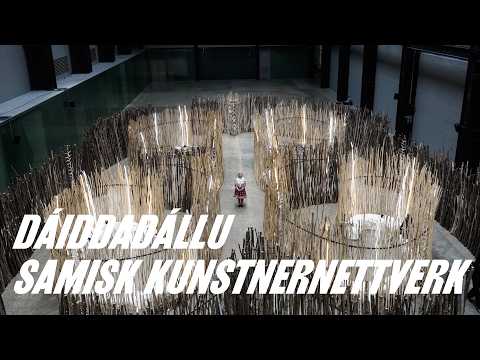
Produced by MUNCH in collaboration with Spindel Film and Dáiddadállu. (c) Munchmuseet.


